
All about cricket – a traditional English sport
All about cricket – a traditional English sport
A real definition
Cricket is a game played between two teams, generally of 11 members each. In essence, it is single combat, in which an individual batsman does battle against an individual bowler, who has helpers known as fielders. The bowler propels the ball with a straight arm from one end of the 22-yard pitch in an attempt to dismiss the batsman by hitting a target known as the wicket at the other end, or by causing the batsman to hit the ball into the air into a fielder’s grasp, or by inducing one of a number of other indiscretions. The batsman attempts to defend the wicket with the bat and to score runs – the currency of the game – by striking the ball to the field boundary, or far enough from the fielders to allow the batsman to run to the other end of the pitch before the ball can be returned. At least two bowlers must take turns, from alternating ends; also, there are always two batsmen on the field, each to take a turn as required. When all but one of the batting team have been dismissed – or after an agreed period – the teams’ roles are reversed. After all the players required to bat on both sides have done so either once or twice (which can take from a few hours to five days) the total number of runs accumulated determines the winner. But sometimes there isn’t one.
Wisden Cricketers’ Almanack
Read the comical definition of cricket
Equipment
Cricket Ball:Hard, cork and string ball, covered with leather. A bit like a baseball (in size and hardness), but the leather covering is thicker and joined in two hemispheres, not in a tennis ball pattern. The seam is thus like an equator, and the stitching is raised slightly. The circumference is between 224 and 229 millimetres (8.81 to 9.00 inches), and the ball weighs between 156 and 163 grams (5.5 to 5.75 ounces). Traditionally the ball is dyed red, with the stitching left white. Nowadays white balls are also used, for visibility in games played at night under artificial lighting. |
|
|
Wickets:There are two wickets – wooden structures made up of a set of three stumps topped by a pair of bails. These are described below. |
HOWZAT!!!! This is the cry made to the umpires by the fielding team when they believe a batsman has been bowled out.(it is an abbreviation of "how’s that?" ie is that out ) |
|
Cricket Bat:Blade made of willow, flat on one side, humped on the other for strength, attached to a sturdy cane handle. The blade has a maximum width of 108 millimetres (4.25 inches) and the whole bat has a maximum length of 965 millimetres (38 inches)
|
|
|
|
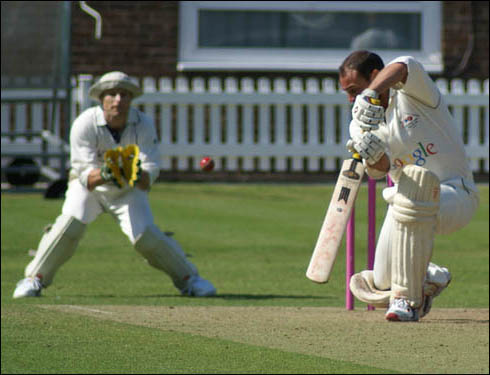
Clothing and protectionPads, gloves, helmet, etc for batsmen to wear to prevent injury when struck by the ball. |



Test your knowledge of cricket in the quiz (the answers are all here!)