No job for a bird-brain!
|
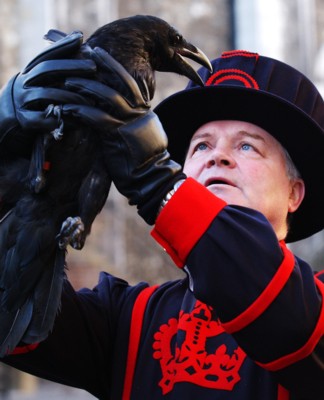
The Ravenmaster Speaks Derek Coyle left the famous Yorkshire regiment the Green Howards in 1983 to come to the Tower of London, where he has been looking after Britain’s most important birds for the last 22 years. JEN OGILVIE spoke to him about life as the Yeoman Ravenmaster and his famous feathered charges. What is a typical day for you as Ravenmaster?In winter, my day will start at 7 o’clock. I will scrub all the water bowls out first. And then I’ll feed the birds, and then I’ll clean the cages out. And then I’ll get myself ready for work. I’ll normally go to work about 9 o’clock. I’ll be on a post within the Tower all day. I check the birds all the time. I’m forever looking at the birds, making sure they’re all right. I’ll feed them in winter again at about 1 o’clock in the afternoon, making sure that every day they’ve all had at least 8oz of meat. Every other day they’ll get a boiled egg and I’ll give them chopped apple, grapes – they love cheese by the way. And then, again in the winter, by 3.30-3.45 it’s time to put them all back to bed. I’ll go back on duty till 4.30, and then my time is my own. In the summer, I’ll have the birds out at 4 o’clock in the morning or whenever it’s light and they won’t be going back to bed again till 9.30 at night. So it is really a very long day. I try to keep the ravens to their natural rhythm. In the wild they would be up at dawn and they’d go to bed at dusk. I try to keep everything here as natural as I possibly can. As regards food, I buy fresh meat from Smithfield – liver, lamb, beef, chicken. And occasionally when I’m at my own place in Suffolk someone will give me some rabbit that’s been killed. If I see roadkill on the road, and it’s not been too badly mangled, I normally put it in a black bag and bring it back here. I give them biscuits as well, soaked in blood from the meat that I buy. And in winter I get them capsules of cod liver oil. I know they’re getting as much vitamins and oil as they possibly can. That’s why they look so healthy.
How long has there been a Ravenmaster at the Tower?The post of Ravenmaster only goes back about 40 years. Before that, they were called Yeoman Quartermaster. There have been ravens here as long as anyone can remember, so someone’s been looking after them all that time, so you could say it goes back to when the ravens first got here. Why did you decide on this is a job?Well, I’m a country boy, born and brought up on a farm, and when I first came here the Ravenmaster at the time said to me: "You’re a country boy, would you like to be involved with the ravens?" and I jumped at the chance. And from then, I was sort of the deputy deputy Ravenmaster, and then I became assistant Ravenmaster, and then when the Ravenmaster retired I became the Ravenmaster, and I have been for the last seven years. But I’ve been looking after the birds for nearly 22 years.
So they all have different personalities?Oh yes. Some of them are shy, some of them are very bold, some of the birds are very bossy. Yes, they’ve all got their own personalities. And do they get on well together?They get on as a group nine months of the year, but in the three months when it’s breeding season the males fight like billy-o. That’s why in the spring the two breeding pair, or the two pair that’s married, have to be separated for their own good, because they’d attack each other. Have you seen any evidence of prophetic abilities?Before my time, three or four of the ravens gathered around one of the yeoman warder’s houses, and they were crowing and squawking, and about 4 or 5 hours later the yeoman warder found out that his son had been badly hurt in a car accident.
|
On the subject of keeping the ravens healthy – what are you doing to protect them against bird flu?Bird flu is one of my big worries at the moment. I’m sort of using Poland or the eastern side of Germany as a buffer. If it gets that near to me, that’s when the birds will go into isolation. I’ve already got the cages built; they’re in a huge room, with enough light and air for them. It’ll be just like being in their outside cages but they’ll be indoors. So they’ll be totally isolated; the only people who’ll deal with them is myself and my assistants. All the measures that I can take are already in place: we’ve got suits, masks, protective gloves, and all the DEFRA-approved disinfectant. So I think my birds will be probably the safest in the country. Are you shooting crows to protect the ravens from bird flu?Yes and no. I do cull the crows but I must emphasise I only kill the sick ones. The crows here are inbred and they do pick up a lot of diseases. You’ll see their eyes are dull; their plumage is very, very dull. A crow will sit in a tree for two days hardly moving and you know it’ s sick. I have a very high-powered air rifle with a huge scope on it and I can zoom straight in on the birds and tell if they’re sick. I don’t cull healthy birds, just the sick ones.
What else do you do to keep the ravens safe?The ravens are caged every night because we do get the odd fox or feral cat. There are domesticated cats too, but when these cats first come in, they only attack the ravens once and they normally come off worse. You see a cat, it’ll give the ravens a wide berth. And the ravens will start calling to each other when they see a cat anyway, and they’ll move out of the way of the cat. They have a healthy respect for each other. And do you have extra ravens in case anything happens to the ones in the Tower?I’ve got 12 ravens that I’ve given away – they were bred here between 1989 and 1991 – to various wildlife parks around the country, and they were given with the proviso that if I go below my recognised number of six, they’ll come back to the Tower. There must be a complement of six at all times, and that’s a decree that goes back to Charles II, he decreed that must be six ravens here at all times.
Tell me about the ravens described being ‘enlisted’ or ‘dismissed’.We had a raven here called George. Now, years ago we didn’t know what sex the ravens were. It’s very hard to distinguish a male from a female. When ravens were taken on, they were normally given the name of the person who found them. George was named after a coastguard in Anglesey. George came to the Tower, was a bit of a loner, used to spend all his time on the doctor’s roof. One day, a Saturday afternoon, the doctor – who was a Scotsman – was watching a Scotland against England rugby match, and all of a sudden the picture went on his television. So he decided to go upstairs onto the roof, and when he got up there, George had actually bitten through the cable. So the doctor wasn’t very happy about that, because he missed the game. Anyway, the cable was repaired, and about 3 months later the doctor’s watching television, the picture goes off, and he thinks: "George". And George was there. So George was retired as ‘services no longer required’. And he went to the Welsh mountains, to Colwyn Bay, where he was put in a great big aviary with another raven. Now George so liked the other raven that George laid an egg, and now he’s Georgina. And Gwyllum, the raven that’s here now, is the product of that egg. So Gwyllum’s mother was here, masquerading as a male. We used to have another raven here called Rhys. Rhys, again he came from Anglesey, and Rhys was the one that used to bark just like a little terrier, and he’d wait till there was a group of tourists on Tower Green and he’d start barking like a dog, and everyone would be looking round for the dog and all they’d see was Rhys. Another one of his tricks was, there’s a great big fountain on Tower Green for anyone to have a drink of water from, and he’d wait till there was a young girl who had long hair and a ribbon in her hair and when she bent down to have a drink Rhys would be there quick as a flash and get her ribbon off and take it on to the grass where the young girl couldn’t go, and he’d then sit there shredding it to bits.
|
|
|
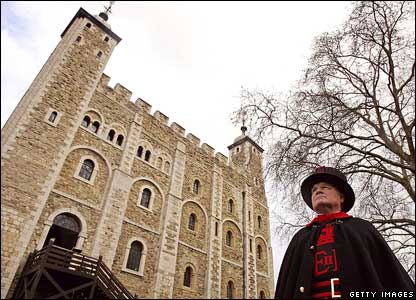
The Myths and Legends regarding RavensIn most parts of the world the raven is considered a prophet and a bad omen, a symbol of the supernatural. Ravens have a place in the myths and legends of many ancient people and are linked to the Greek Goddess Hecate and the Norse God Odin as symbols of the underworld. The croaking of a raven is believed to represent the speech of the dead! The raven is also mentioned in Celtic myths and legends and has been associated with the raven goddess of Battle and Strife – Morrigan, and the son of the Sea God called Bran Fendigaid (The name ‘Bran’ means Raven). These myths and legends prevailedin folklore ultimately leading a story linking them to the Tower of London: A Medieval chronicler called Geoffrey of Monmouth recorded stories of many Welsh Celtic legends and Myths. In 1136 Geoffrey of Monmouth wrote a book called Historia Regum Britanniae – the History of the Kings of Britain. In this book Geoffrey of Monmouth refers to an early British King called King Bran Hen of Bryneich (born c.485). This ancient King of the Dark Ages was killed in a battle and requested that his head be buried, as a talisman against invasion, on Gwynfryn (the ‘White Mount’) where The Tower of London now stands. To this day ravens are accepted as highly important and necessary occupants of the Tower of London. Legend has it that should the ravens ever leave the Tower of London the White Tower will crumble and a great disaster shall befall England. King Charles II is believed to be the Monarch who decreed that at least six ravens should be kept at the Tower at all times to prevent disaster. The unconfirmed story of his involvement seems to be as a result of a matter concerning John Flamsteed (1646 – 1719) who was the ‘astronomical observator’ at that time. The Royal Observatory was housed in the north eastern turret of the White Tower and John Flamsteed complained to King Charles II that the ravens were interfering with his observations. The King ordered their destruction but was told that if the ravens left the Tower of London that the great White Tower would fall and a terrible disaster would befall England. Not wanting to tempt fate by flouting ancient legend King Charles changed his mind and decreed that at least six ravens should be kept at the Tower at all times to prevent disaster. The die was cast, and since that time, the Tower has always retained that number of ravens. |