
The Least Successful Exit – answers
1 A residential home. The former word for these homes was ‘An Old People’s Home’ or ‘An Old Folks’ Home’. Did you spell the ‘chal’ sound correctly?
2 Yorkshire. Did you recognise the ‘she’ sound in the name of the county?
3 A fence.
4 To give it / them more privacy. Did you spell this noun correctly?
5 In 1979.
6 Picks, shovels and planks of wood. Did you guess how to spell ‘shovel’? If you did, you did well!
7 Five days.
8 Erect.
9 It was 3½ / three and a half feet high and 100 yards long.
Note
When measurements are used adjectivally, we say a three-and-a-half-foot-high and 100-yard-long fence.
10 A gap (through which to drive their lorry out – so they had fenced themselves in!)
11 ‘It was like a Laurel and Hardy film.’
Note
A Laurel and Hardy film
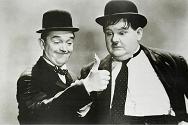
One of the most famous comedy double-acts in motion-picture history Laurel and Hardy were the American-based comedy team of thin, British-born Stan Laurel (1890-1965) and heavy, American-born Oliver Hardy (1892-1957). They became famous during the early half of the 20th century for their work in motion pictures, and also appeared on stage throughout America and Europe.
12 They ‘wondered about the lorry’ – i.e. they noticed something strange.
If you ‘wonder about‘ something you have reservations or ideas about some matter, but feel hesitant to say or ask anything.
Eg I wondered about inviting them, but they seemed uninterested, so I didn’t press it (i.e. insist). (or I wondered whether to invite them, but they didn’t show any interest in joining us, so I didn’t.)
13 They did not want to ‘interfere’. If you ‘interfere’ in a matter it implies your contribution might be unnecessary or unwanted, that it is none of your business.
"It is none of my business" – it does not concern me, or it is not my place to comment on sth or have an opinion about it.
14 That it was an oversight, and that the workers had perhaps ‘got carried away’ in their work. Did you spell oversight as one word? Did you remember to change the y in ‘carry’ to an i ?
An oversight – an unintentional failure to notice or do something The verb linked to this noun is to overlook – which means 1) to fail to notice 2) to ignore or disregard, pass over in favour of someone else 3) to have a view of a place from above.
Examples:
i I overlooked the fact that lunch was scheduled for 12.15, so we were all late arriving at the canteen.
ii He’d hoped for a promotion this year, but was overlooked because of the arrival of a bright young man in the marketing department.
iii Our house overlooks the River Tay.
Note: The verb to oversee is entirely different from the verb to overlook.
To oversee means to supervise
Eg The two boys wanted to make some chips, but of course we had to oversee them a bit so they didn’t burn themselves.
To get carried away – phrasal verb – to lose control, to become involved in an activity with such enthusiasm or commitment that you do not stop when you should, or do not notice the time or some other factor such as people’s reactions.
Eg He was supposed to talk for about 10 minutes, but he got a bit carried away, and we were there for over an hour. (This might be a fantastic bonus, listening to someone interesting for such a long time!).
Eg I shouldn’t have started shouting about the boss’s incompetence, but I got a bit carried away. (Here the individual might end up regretting getting carried away!).
15 Part of it got knocked down. Did you write ‘ed’ in knocked even though it sounds like a ‘t‘?