
Messing about on the water?
|
Sam Clarke works for British Waterways on a four mile stretch of London’s Grand Union Canal, adjusting the water level by opening and closing locks so that there is enough water depth for boats to cruise along the waterway. How would you outline your role?I am responsible for four locks on the canal between Brentford and Ealing. Two are operated electrically and the other two manually. There are also two weirs, which allow the natural flow of water to run over, maintaining a constant water level. What are your main responsibilities?I operate the locks according to the tides, in order to let boats in and out. I check details of the people on the boats, issue canal licences, and give out customer care packs, containing maps and information about the canals and places of interest nearby. I also maintain the locks and weirs and keep my length of canal tidy and clear of rubbish. |
 |
 Grand Union Canal Grand Union Canal |
What hours do you work?I work four days and then have two off. During the winter, my hours are 8.00 a.m. to 4.00 p.m. For the rest of the year it’s until 6.00 p.m. The locks are open every day except Christmas Day. There’s a pre-booking system, which means that if canal users give 24 hours notice the locks will be opened for them at a pre-arranged time between 5.00 a.m. and 10.00 p.m. This system means I may have to work extra hours. What’s your working environment like?It’s a beautiful stretch of countryside running like a corridor through an urban area. Parks, golf clubs and riverside walks border the river. It’s a great place to work through every season of the year and I love it. Who do you work with?There’s a team of three lock keepers. I’m the residential lock keeper, which means I live in a British Waterways house close to the canal. What special skills or qualities do you need for your job?Lock keepers need to be practical people and good at repair and maintenance. I was a trained welder before taking up this job. Customer care skills are also important, talking to people from different backgrounds about the canal, giving advice and solving their problems. You need plenty of common sense to deal with whatever happens, plus enthusiasm for canals.
|
Why did you choose this type of work?It was a case of being in the right place at the right time. I worked in a factory, and one day by chance overheard there was a vacancy for a lock keeper. I applied and got the job. I’ve always enjoyed going on long walks and boating holidays. What training have you done?When I started I went on an induction course about the business side of this job. I have also been on various courses involving health and safety issues and canal work. Do you use any tools or equipment?Wrenches, spanners, cutting gear, welding equipment and wood working tools for general maintenance. We also have a boat fitted with a hydraulic crane, which is extremely useful. What do you like about your job?I love working outside on the canal. What do you dislike about your job?I have young children, and working on weekends means I tend to miss out on family activities. How do you see your future?There are lots of opportunities, but at present I’m perfectly happy doing this job. What are the particular challenges in your work?Keeping the canal in good order can be hard work, especially early in the spring, when we’re clearing the ground, cutting back trees, and painting the locks.
|
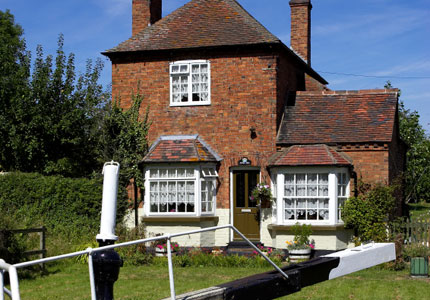 A lock keepers cottage A lock keepers cottage |
Read about Five Rise locks on the Leeds Liverpool canal (pictured below) and see more wonderful photographs of their setting

Have a go at the quiz